

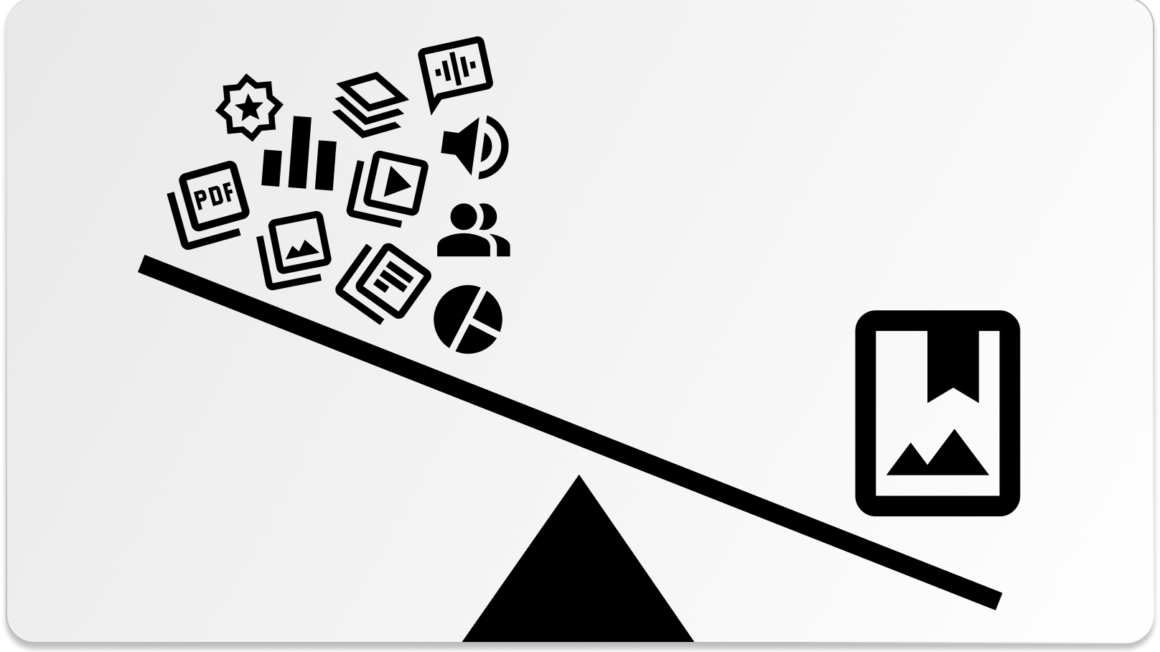
As a program director, the lead-up to a site visit or a self-study submission often feels like a high-stakes trial. You know your faculty are dedicated and your students are achieving, but a common anxiety remains: Have we proven it? In the effort to be thorough, many programs fall into the “data dump” trap—the belief that if you provide every syllabus, every meeting minute, and every student assignment from the last five years, the reviewers will surely find the truth.
In reality, this strategy often backfires. To succeed, you must understand a specific evaluative concept used by almost all specialized accreditors: Preponderance of Evidence.
Defining the Standard: The “51% Rule”
The term “preponderance of evidence” is not an educational invention; it is a legal standard of proof. In the American legal system, it is the evidentiary standard used in most civil cases. Unlike “beyond a reasonable doubt”—the famous criminal standard that requires near-certainty—preponderance of evidence simply asks:
Is it more likely than not that the claim is true?
In the context of program accreditation, this is often referred to as the 51% rule. You are not required to demonstrate absolute perfection in every single student artifact or prove that every single faculty member follows every policy 100% of the time. Instead, you must persuade reviewers that compliance with programmatic standards is the consistent norm, rather than a series of lucky decisions or a narrative manufactured just for the report.
The Reviewer’s Burden: Signal vs. Noise
It is vital to remember who is reading your report: Peer reviewers are volunteers. They are fellow educators, administrators and practitioners juggling their own full-time roles while trying to navigate your evidence in their “spare” time.
When a program throws a mountain of unorganized files at a reviewer, it doesn’t signal thoroughness; it signals a lack of clarity. In legal terms, “more evidence” does not always equal “more weight.” If the evidence is redundant, tangential, or disorganized, it actually lightens the scale because it obscures the truth and creates fuzzy margins.
Here is why the “everything but the kitchen sink” approach is risky for your program:
- Reviewer Fatigue: Navigating through hundreds of poorly labeled PDFs is exhausting. An annoyed reviewer is less likely to give your program the benefit of the doubt on borderline standards.
- Hiding the “Special”: Every program has “signature” strengths—perhaps a unique capstone project or a stellar internship placement rate. If these are buried under 50 pages of routine committee attendance logs, the reviewer may never find what actually makes your program excellent.
- The Burden of Proof: It is not the reviewer’s job to “find” the evidence for you. In a legal setting, if a lawyer presents 1,000 documents without explaining their relevance, the judge may dismiss them. Similarly, if a reviewer has to hunt for the connection between your narrative and your artifacts, you have already lost the argument.
Your goal is to reduce the noise so the signal of your program’s quality can be heard clearly.
Tipping the Scales Through Curation
In a courtroom, a preponderance is reached when the “greater weight” of the evidence supports one side. In accreditation, “weight” is determined by relevance and quality, not page count.
To tip the scales in your favor, you must act as a curator rather than a collector. Before including an artifact in your program’s submission, subject it to a simple check:
“Does this clearly and directly support the “more likely than not” conclusion for this specific standard?”
If you have one high-quality summary report that shows three years of consistent student achievement, that single document carries more “weight” than thirty individual student papers. By putting your strongest, most direct evidence front and center, you allow the reviewer to see the 51% threshold has been met immediately. If they want to verify with underlying documentation they will ask for it but this is rare in my experience.
Conclusion: Lead with Clarity
Accreditation is an ongoing cycle of Build → Organize → Review → Submit → Maintain. At the submission stage, your primary job is to be an editor (a ruthless editor).
By focusing on the preponderance of evidence and curating your documentation to highlight clarity over volume, you respect the reviewer’s time and make it easy for them to say “met.” When you reduce the noise and lead with a focused, weighted argument, you aren’t just checking a box—you are showcasing the true quality and integrity of your program.